Lugh
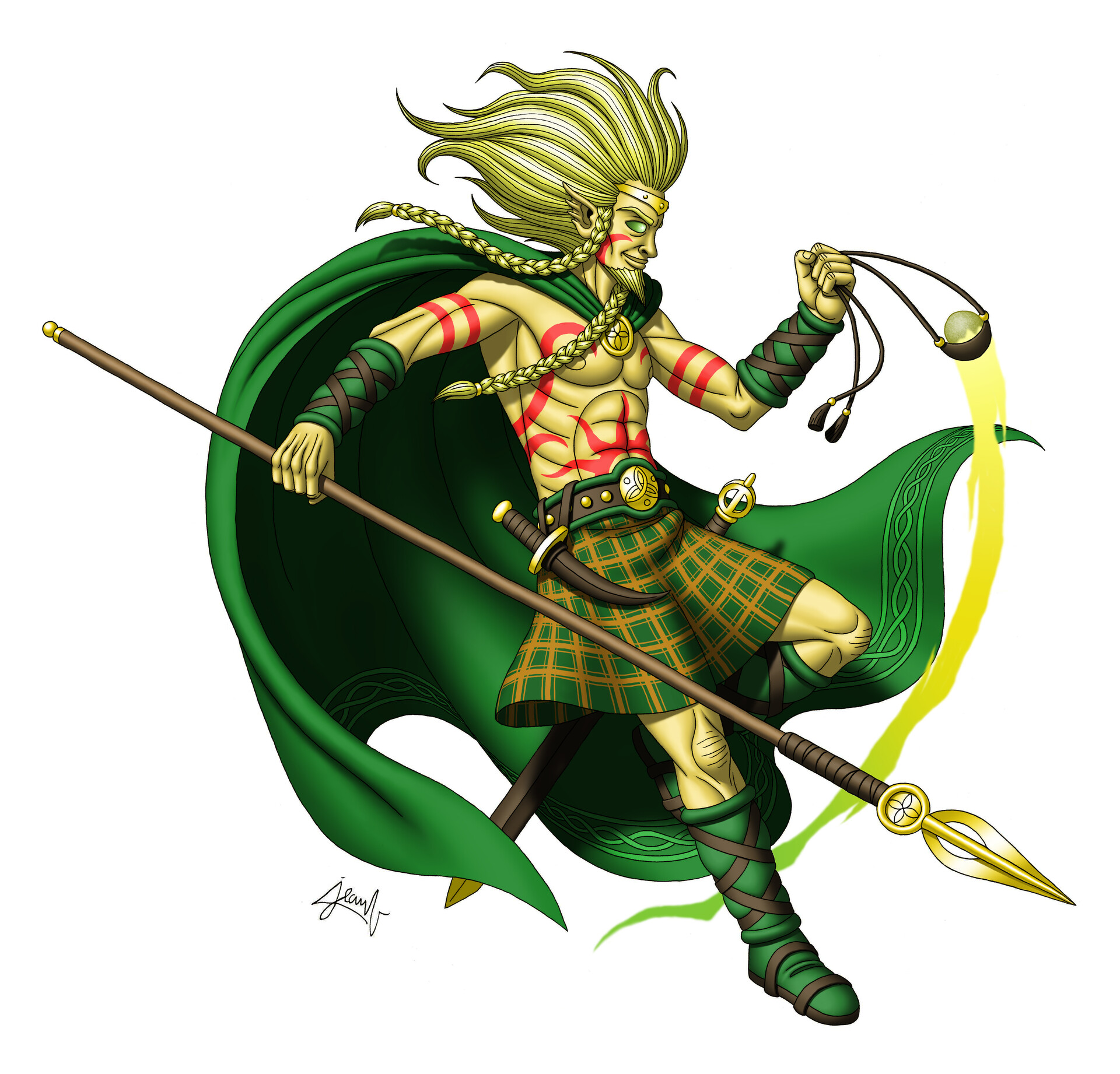
Here is my vision of Lugh, the polytechnician god of Irish Celtic mythology, nicknamed Lamhfhada, which in Irish Gaelic means "of the long arm", in reference to his skill with the spear. Although equivalent deities exist in the Gallic and Welsh pantheons (Lugus and Lleu Llaw Gyffes respectively), it is the Irish one that remains the best known. In "The Cattle Raid of Cooley" (around the 9th century) Lugh is described as a tall and handsome warrior, with a blond mane and wearing, among other things, a green mantle ; then, in "The Fate of the Sons of Tuireann", his physical appearance is repeatedly compared to the sun. But the interpretation of Lugh as a sun god should be taken with caution.
He was the son of the Fomorian Eithne, daughter of King Balor of the Evil Eye, and the god Cian. The King of the Fomorians having been informed by a druid that his grandson would grow up to kill him, he had his only daughter locked up in a high tower on Toraigh Island, in the north-west of the country, with twelve maids in charge of preventing any man from meeting her for only company. But Balor later drew the wrath of the god Cian, after seizing his cow with milk of supernatural abundance. The god, with the help of a fairy, first seeking revenge, reached the top of the tower, where he met Eithne, whom he ended up seducing. The latter later gave birth to triplets that Balor, with rage, sent to be drowned by one of his lackeys. The servant threw two of the newborns into a whirlpool, but unwillingly let the third escape, which was saved by the same fairy who had allowed the meeting of his two parents, before she entrusted it to Goibniu, blacksmith god and brother of Cian (in other versions, she entrusts it to Manannan, the god of the sea).
Grown up, Lugh went to the court of Nuada of the silver arm, the ruler of the Tuatha Dé Danann, the Celtic gods of Ireland, in order to offer him his services. However, he was asked what skill he could possibly offer. Lugh then volunteered as a carpenter, blacksmith, swordsman, harpist, poet, historian, wizard, craftsman, and other trades, but every time he was told that a god already had this talent. In the end, the young god asked them if they had in their ranks a single god mastering all these skills at the same time, proved himself, and was admitted to King Nuada, officially as Chief Ollam (a kind of historian and literary bard with a social status as high as that of a King). At that time, the Tuatha Dé Danann were at odds with the Fomorians, and soon the gods prepared for war, motivated by Lugh.
The polytechnician god led his people against the Fomorians during the Second Battle of Magh Tuireadh. Nuada was killed there by Balor, but soon after, Lugh, armed with his magic slingshot, among other things, threw a stone straight into the huge eye of his grandfather, who died instantly. The destructive eyeball was bulged out and sent into the ranks of the monstrous army, causing monumental losses. Following this battle, the Tuatha Dé Danann regained control of the country, with Lugh as the new King. Lugh reigned 40 years, until one of his wives cheated on him with Cermait, son of Dagda, the Druid god. Indeed, Lugh killed Cermait out of revenge, but the latter's sons killed him in turn, piercing him with a spear, then drowning him in a loch. But before all this, Lugh will have had time to conceive the demigod Cu Chulainn with Deichtine, sister of the King of Ulster, to create the feast of Lughnasadh, celebrating the start of the harvest season in August, and the Fidchell (a predecessor of chess).
In addition to his slingshot and the Fragarach sword (which he inherited from Nuada), Lugh possessed other magical items, including three different spears: the first, Gae Assail, never missed its mark, and always came back to his handler; the second, Areadbhair, had a tip so hot that it would ignite if it was not immersed in water; then the third had its own bloodthirsty will, slaying the enemy ranks on its own. The Lugus from Gaul was more certainly associated with the sun, sometimes even represented on a chariot worthy of Apollo on coins from the 3rd century B.C, which will not prevent it from being perceived as an avatar of Mercury by Julius Caesar. As for the Lleu Llaw Gyffes of Wales, he had in common with Lugh only his polytechnic warrior aspect.