Mithras
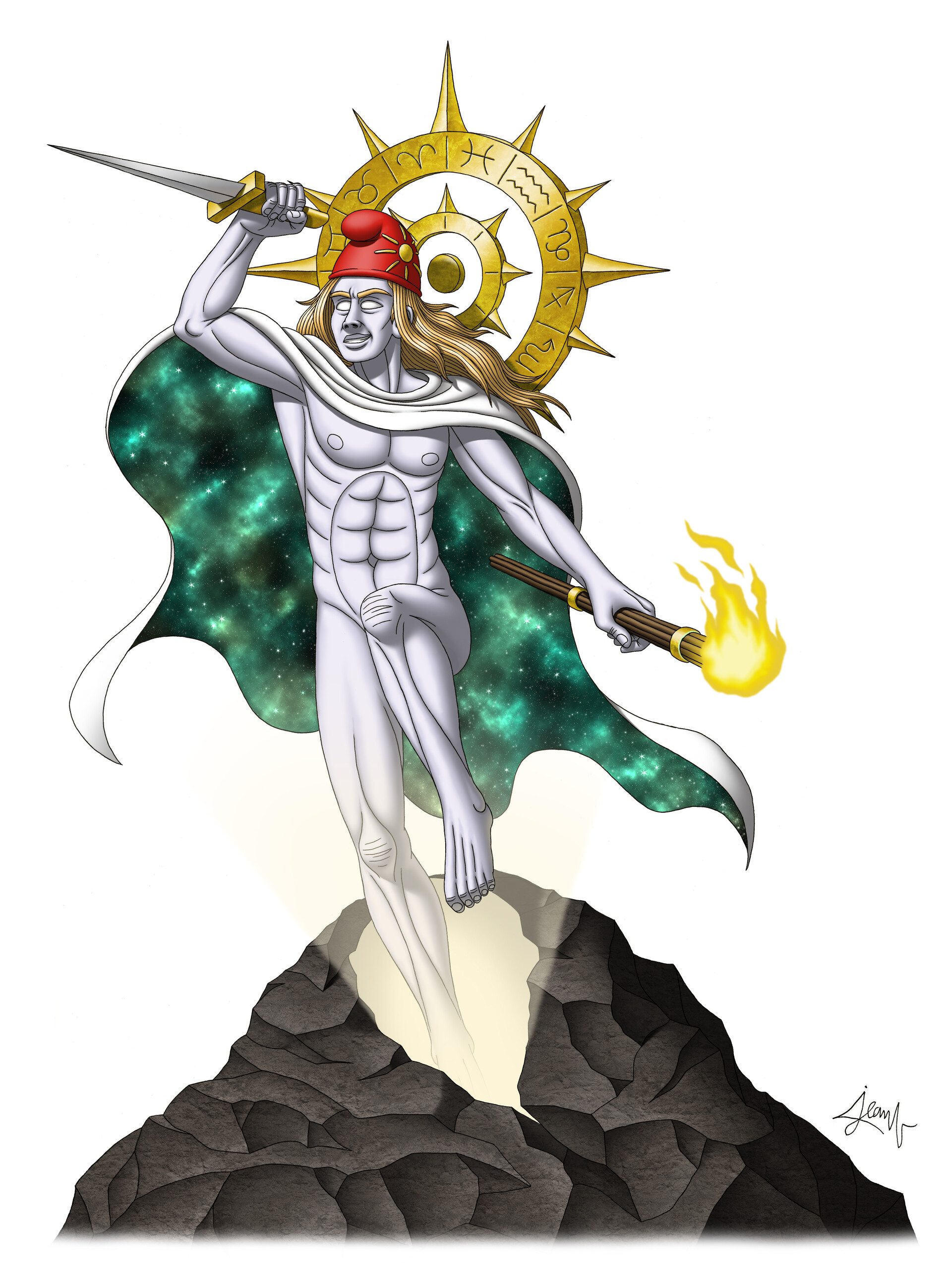
Here is my vision of Mithras, the central deity of Mithraism, a mystery cult which was practiced throughout the Roman Empire (as far as Great Britain) between the second half of the 1st century and the end of the 4th century of our era. He has his origins from Mithra, the Persian god of contracts, light and oaths, who himself was a derivative of Mitra, the god of covenants of Vedism (the ancestor of Hinduism). But the Roman god was very distinctive from his oriental homonyms.
Mithras was born from a rock, the "petra genetrix", already having the body of a young man, brandishing a dagger (symbol of truth) in his right hand, a torch in his left hand, and wearing a Phrygian cap (sign of his Eastern origins, Phrygia corresponding to present-day Turkey). The event would have taken place in a cave on December 25, so 3 or 4 days after the winter solstice, although other solar deities were honored on that date, before Mithras and later Jesus Christ. Moreover, he first humans to meet him were shepherds, who adored him. Later in his life, the god created a source of beneficial water by shooting an arrow on a rock.
After an uncertain temporal ellipse, as he wandered through the pastures, Mithras was visited by a raven, the messenger of Sol, the sun. The bird told him that he had to hunt down and sacrifice the Bull, in order to regenerate the world, and to restore a certain cosmic balance ; it is the "tauroctony". The god found the animal, rode it until it was exhausted, then carried it on its back to a cave, where he slaughtered it by sticking his dagger in its neck. As soon as the fertile blood began to flow from the wound to the land it was intended for, several other animals (seen as negative figures opposing the rebalancing of the world) rushed over it. A dog and a snake came to lap up the blood coming from the wound, while a scorpion came to pinch the testicles of the bovine, seeking to recover all its semen, also perceived as a fluid capable of fertilizing the world. Where the Bull's blood touched the ground, vegetation sprouted .... in the end, most of the liquid was collected by Mithras (or by Luna according to other sources) in a crater / vase. New forms of life useful to humanity were born from this sacrifice.
Once the balance was restored, several figures came to meet the triumphant god : Cautes and Cautopates, kinds of assistants of Mithras representing respectively the rising sun and the setting sun, Luna, the moon, and Sol, patron of the "tauroctony". A great banquet took place on the Bull's hide, at the end of which Sol invited Mithras to return with him to the heavens in his chariot. Thus, the earthly life of this god who lived among men ended with an apotheosis, an assumption.
As with most esoteric cults, reserved for initiates and practiced in secret, the history of Mithras is difficult to study, but rich in symbols which, if they are familiar to us, allow us to have other levels of reading . Mithras is certainly considered a god, but his earthly life ending with an ascension to Heaven may mean that he would be the first initiate, and that he would have attained enlightenment or would have surpassed the material world (the followers of his cult believed in reincarnation). On his many sculpted representations (found in buildings without windows and sometimes underground called mithraeum), whether it is about his birth or the "tauroctony", Mithras is often surrounded by the twelve signs of the zodiac, some of which are particularly evident, like Taurus and Scorpio. In addition, he often wears a cape emblazoned with stars in depictions of the "tauroctoniy", which, like the legend of Theseus and the Minotaur, could be interpreted as the struggle of the man in search of wisdom against his bestial instincts
His birth from a rock in a cave and the fact that his places of worship were generally underground, adding to his association with the stars and his apotheosis, it becomes very tempting to consider Mithras as a link between the earthly forces and the celestial ones. He is also a god of light, just like his Persian homonym, and of cosmic order, which he brings back by sacrificing the Bull.
In the 3rd century CE, the figures of Mithras and Apollo were mixed to give birth to Sol invictus, the "undefeated sun", who was sometimes confused with the god of Mithraism, while being the only god of a true exoteric (accessible to everyone) religion. But the cult of Mithras came to an abrupt end in 391, when Emperor Theodosius issued a decree ordering the destruction (or rehabilitation) of any place of non-Christian worship. And many writings dealing with Mithraism were the work of Church fathers (Tertullian for example) seeking to demonize it. It is therefore necessary to be cautious when learning about this mysterious divinity and his cult ...
Here it is, the 100th drawing of this series !