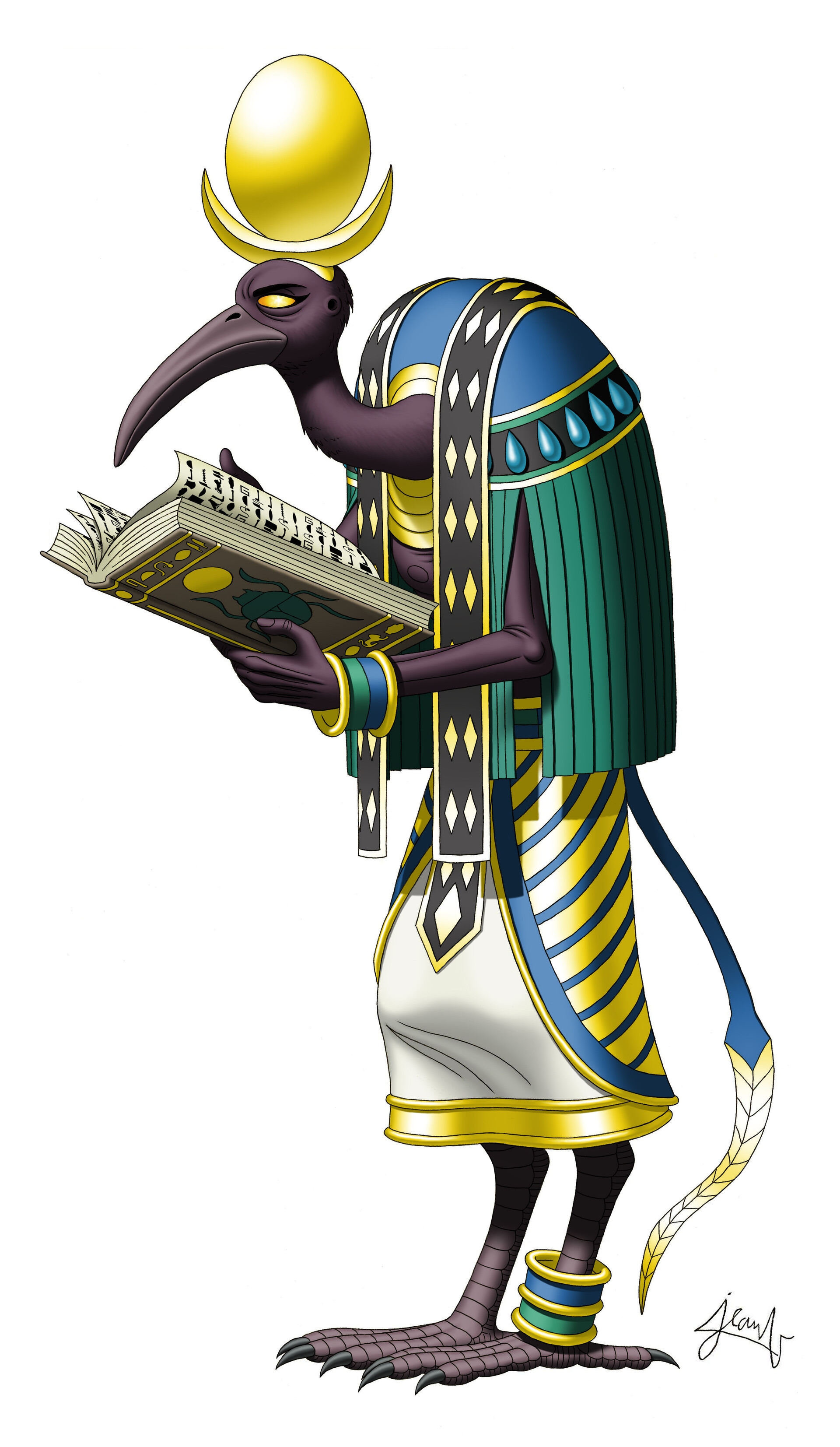
Thoth
Here's my vision of Thoth (or Djehuty), the Egyptian god of knowledge, writing, wisdom, the moon, time, science, and magic. The Egyptians most often represented it with the head of an ibis, this bird capable of differentiating drinking water from non-drinking water, but they also gave it the appearance of a hamadryas baboon on certain occasions, this monkey uttering territorial screams at sunrise. True brain of the Egyptian pantheon, with unlimited knowledge, creator of all sciences, he had given himself the mission of transmitting his knowledge and his know-how to mortals, through writing, which he had invented for that reason.
As with many other deities in Egypt, Thoth's duties tended to vary between each major city of the country. In Hermopolis for example, he was considered the demiurge who "created the world by the verb" according to a text found in Edfu. However, other gods had preceded him in this same cosmogony, including Ra, his father.
However, it is not this version of Thoth which spreaded the most. In most other Egyptian cosmogonies, he was certainly ancient, created by Ra-Atum, the primordial god according to the Ennead of Heliopolis, possessed incredible powers, but he lived more among his fellows, and was not a creator god. He was the vizier of Ra, dealing with the mediation of conflicts between divinities, but was also a scribe/clerk, noting everything on tablets, and attending the weighings of hearts orchestrated by Osiris and Anubis. Thoth had for companion Maat, the primordial goddess of truth and justice, with whom he presided over all the actions of Pharaonic justice. But in other versions, the god had for wife the goddess Nehemetawy, with whom he had a daughter called Seshat, who had, in the cosmogony of Hermopolis, the intellectual and technical functions which were not associated with the creator Thoth in this version.
Thoth is said to have laid out the plans for the sanctuaries of the gods, defined the borders of Egypt and its number of administrative districts. He was the "patron saint" of architects, mathematicians, scribes, and teachers. Moreover, humans could have developed their technical skills after discovering writings that Thoth would have willingly left on Earth.
Another function which was attributed to Thoth since his first mentions was that of god of the moon - whose cycles he governed - and of time. Through his powers in these areas, he allowed Nut (goddess of the sky) to unite with Geb (god of earth) while the two were kept separate and made sterile by Shu (god of air) permanently. Indeed, the years lasted 360 days in those remote times, but Thoth lengthened them by 5 days, allowing Nut and Geb to conceive Osiris, Isis, Set, and Nephthys.
When Set, the god of the desert and of storm, murdered his brother Osiris, then pharaoh, Thoth assisted Isis in her quest to resurrect her dismembered brother, before making him ruler of the land of the dead. In the conflict between Horus and his uncle Set, Thoth sided with the former, the legitimate heir to the throne of Egypt as the son of Osiris. The two rivals challenged each other : whoever will stay submerged the longest in the water of the Nile after changing into a hippo will become the new pharaoh. However, Isis, anxious to help her son Horus, tried to harpoon Set, but unfortunately touched her son, who, furious, beheaded her and withdrew into the desert with his mother's head. Thoth then gave Isis a new head, in this case of a cow (explaining that the goddess is sometimes represented with horns). Later, when the storm god tore one of his nephew's eyes, Thoth designed the famous Udjat from the fragments of the organ. Also called Eye of Horus, it allowed its owner to see the invisible, and to obtain much hidden knowledge. With this artifact, Horus was able to take his place on the throne, after Thoth had played his key role of mediator between the two parties. Moreover, in another version of this story, reported by the Egyptologist Herman te Velde, Thoth would have been born from Set's forehead to settle this conflict, after the latter had received the semen of Horus, which had retaliated following an attempted rape of his uncle.
The Greeks, by syncretism, identified Thoth with Hermes, the messenger of the gods, but by naming him Hermes Trismegistus (three times great). It is to this composite figure that the writing of the Hermetica, at the basis of the Hermetic doctrine, and of the enigmatic Emerald Table, which contains all the occult knowledge of the Greco-Egyptian god, will be attributed.