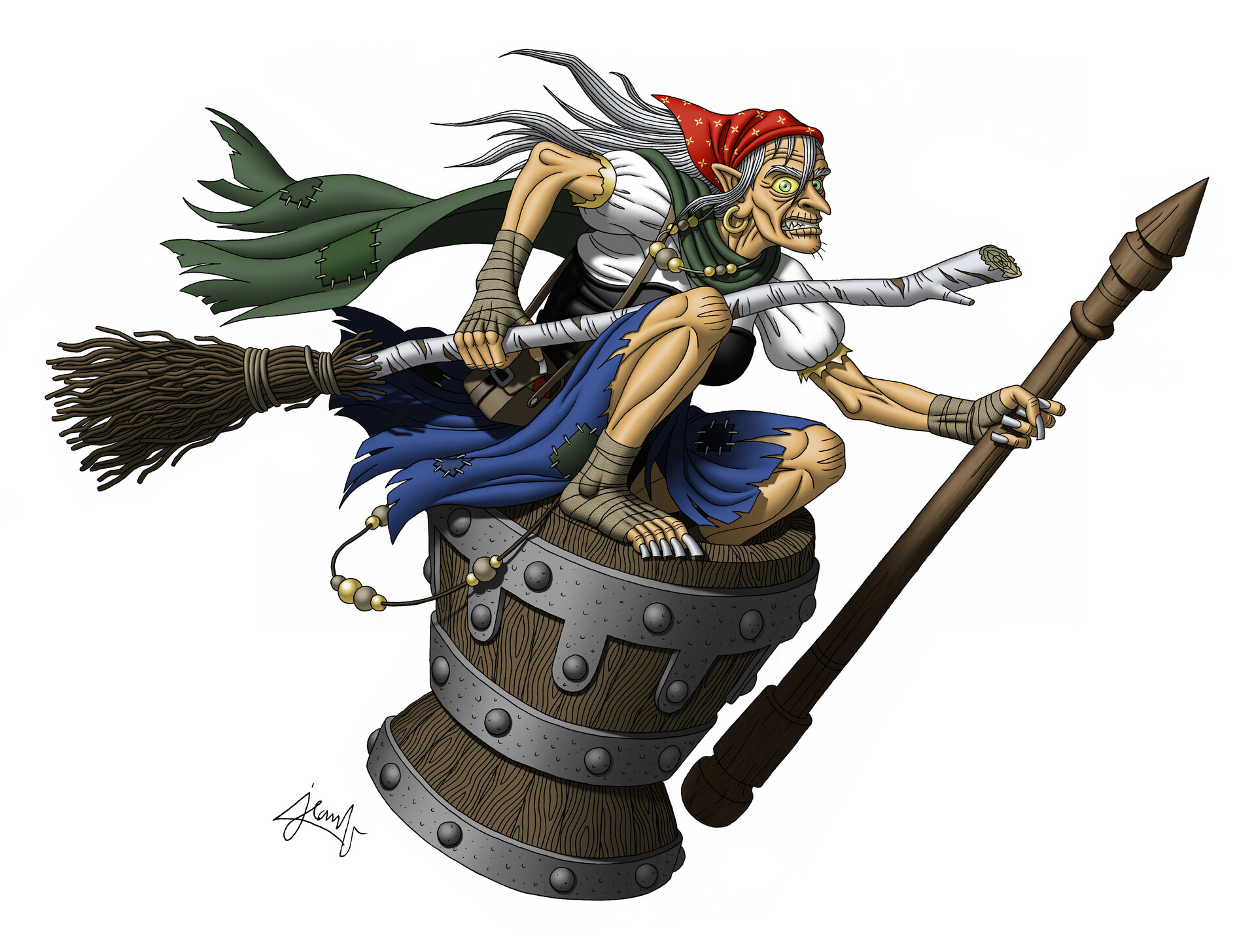
Baba Yaga
Here’s my take on Baba Yaga (or Ježibaba in Czech), one of the most famous witches in the world, from Slavic folklore ! The Russian term "baba" (diminutive of "babushka") can be translated as "old woman", or "grandmother", or even designate an old peasant woman. As for the word "Yaga", it would be a proper name, although there is no consensus on its true meaning ; it could come from the Polish term "jędza", designating a wicked woman or a "fury", or from the Czech "jezinka", which can be interpreted as "wicked wood nymph", or from the Slovenian "jeza", meaning "anger". In many stories, she is nicknamed "Baba Yaga with the bony leg", or "Baba Yaga with the iron teeth".
One of the oldest written traces of Baba Yaga dates back to 1775, in a work on Russian grammar written by Mikhail Vasilyevich Lomonosov, a man of letters and science ; but as early as the 17th century, she was depicted on lubki (popular woodcuts). This witch appears in many Russian tales, but she does not always have the same role, being sometimes the adversary, sometimes the ally of the hero or heroes. Her powers, attributes and appearance tend to vary, but in all cases, she remains associated with wild forest environments.
The most widespread version of the character is that of a terrible and powerful witch, repulsive and cannibalistic. Flying in her magic mortar, propelling herself with her pestle, and erasing any traces she may leave with her broom, she hunts in the forest, looking for lost children to abduct (especially boys). Her lair is a sinister hut/isba mounted on enormous chicken legs, sometimes moving, sometimes rotating on itself in the middle of an enclosure built with the bones of her victims, decorated with skulls with glowing eyes. Her home is generally located in an undefined place, sometimes called the "distant tsardom", separated from the "known world" by an impenetrable forest, precipices, or even a river of fire. Usually, the children she takes home are destined to end up cooked in her oven, then devoured. However, the young heroes of the tales in which she plays the role of villain always end up escaping her, often by taking advantage of the fact that Baba Yaga is out hunting, or by making an ally of the witch's young daughter.
But as we have said, Baba Yaga is not just a simple evil "ogress". For example, she plays a less negative role in the tale Vassilissa the beautiful. The young heroine, tormented by her stepmother and her two stepsisters in her father's absence, is one day sent by them to ask Baba Yaga for fire, doubtless hoping that she will end up devoured. Once in the presence of the fearsome witch, Vassilissa explains the reason of her visit, not without trembling. But Baba Yaga tells her that she knows her sisters-in-law, and decides to take her into her service. The young girl carries out the tasks imposed by the witch (especially involving the sorting of wheat and poppy seeds), helped by a magic doll that her mother had given her before she died. Each time, Baba Yaga is satisfied, and leaves three pairs of disembodied arms to take care of the rest of the operations. But one day, Vassilissa ends up admitting that she is helped by her mother's blessing, and the irritated witch chases her away, not wanting "any blessed people in her home". Nevertheless, Baba Yaga gives the young girl a skull with flames in its eye sockets, remembering that her in-laws had sent her to get fire in the first place. But once Vassilissa returns home, the bewitched skull attacks the stepmother and her daughters until it consumes them, ridding the heroine of her tormenters.
In the tale Maria Morevna, the hero – Prince Ivan – is led to go to meet Baba Yaga to save Maria from the clutches of the sorcerer Koshchei. Having failed three times to help his beauty escape because he was caught by his enemy's mount, Ivan inquires about the origin of the steed, and learns that it is a gift from Baba Yaga. The prince then sets off, armed with a magic scarf allowing him to cross the river of fire separating him from the witch's domain. Once in front of her, he asks her to provide him with a faster steed than the sorcerer's. But Baba Yaga demands that he guard her herd of horses for three days ; if he succeeds, she may agree to help him, and if he fails, his head will end up on a stake. Ivan accomplishes his task, helped by animals he met along the way ; but a bee suggests that he steal a mangy foal from the witch and escape on its back in the middle of the night. After crossing the bridge he had made appear over the river of fire with his scarf a second time, he reduces it to the width of a thread. When Baba Yaga wakes up, she discovers the crime and chases the prince, aboard her mortar. But when the witch steps onto the bridge that has become a wire, it gives way, and she ends up dying in the infernal waters. And I don't have room for the rest of the description...