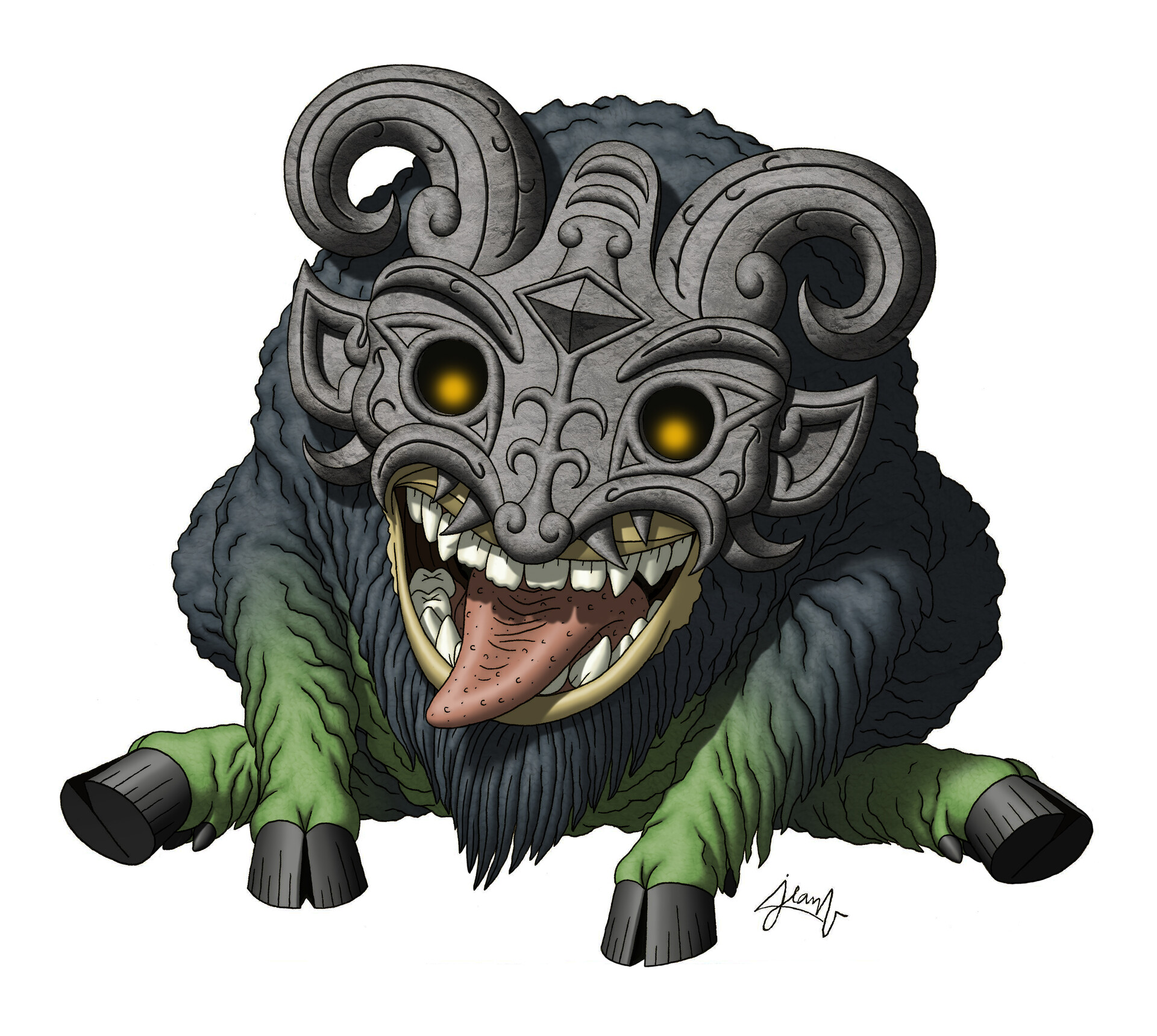
Taotie
Here's my vision of the Taotie (also spelled Tao Tie, called Toutetsu by the Japanese), a creature with a gargantuan appetite considered one of the Four Perils, harmful beasts opposed to the Four Animals which gard the cardinal points in Chinese mythology. These latter are Qing Long (the Azure Dragon of the East), Xuan Wu (the Black Tortoise of the North), Bai Hu (the White Tiger of the West) and Zhu Que (the Vermilion Bird of the South), and are quite well known. On the other hand, the Four Perils, although named in the Classic of the Mountains and the Seas written between the 4th century BC and the 1st century AD, are more obscure, and are neither linked to precise cardinal points, nor to colors. These creatures are the Hundun (symbol of chaos and amorality), the Qiongqi (associated with depravity and reversal of values), the Taowu (full of violence and stubbornness), and finally the Taotie, which we are going to talk about in more depth.
This monster is a symbol of greed and gluttony, and according to the Book of Gods and Strange Things (or Shenyi Jing) by scholar Dongfang Shuo, it looks like some kind of hybrid between a sheep and a pig (with a deformed human head on some representations), particularly dangerous for lone travelers, and fond of hoarding precious objects, like European dragons. The Taotie would once have been a human, the inept, gluttonous and greedy son of an official who lived during the reign of the legendary Yellow Emperor, but the circumstances of his metamorphosis are not detailed. Other sources say the monster has eyes so much bigger than its belly that it is doomed to harm itself by always wanting to eat bigger than it can swallow, or even by going so far as to devour his own body ; his story then takes on the aspect of a warning.
During the Jin dynasty (266 to 420), the historian Guo Pu associated the Taotie with the Paoxiao, another creature described in the Classic of the Mountains and Seas, but apart from their dangerous voracity and their hooves (only on the hind legs for the Paoxiao), they have nothing in common.
The Taotie is also associated with very recurrent zoomorphic motifs on ritual bronzes dating from Chinese antiquity, precisely from the Shang (1570 to 1045 BC) and Zhou (1046 to 256 BC) dynasties. These patterns were visible on funerary wares more than on everyday objects, and were recognizable by their appearance of an animal face, with large eyes, pointed ears, ram's horns, and a wide mouth that seemed to lack a lower jaw. However, at that time, the creature called Taotie had not been conceptualized, the various texts mentioning and describing it dating from the Han dynasty (206 BC to 220 AD). It was only during the Song dynasty (960 to 1279) that scholars and antiquarians, in full rediscovery of these bronzes and inspired by the texts of the Han dynasty, did associate the two durably, making these zoomorphic motifs a warning against greed and gluttony.