Xiuhtecuhtli
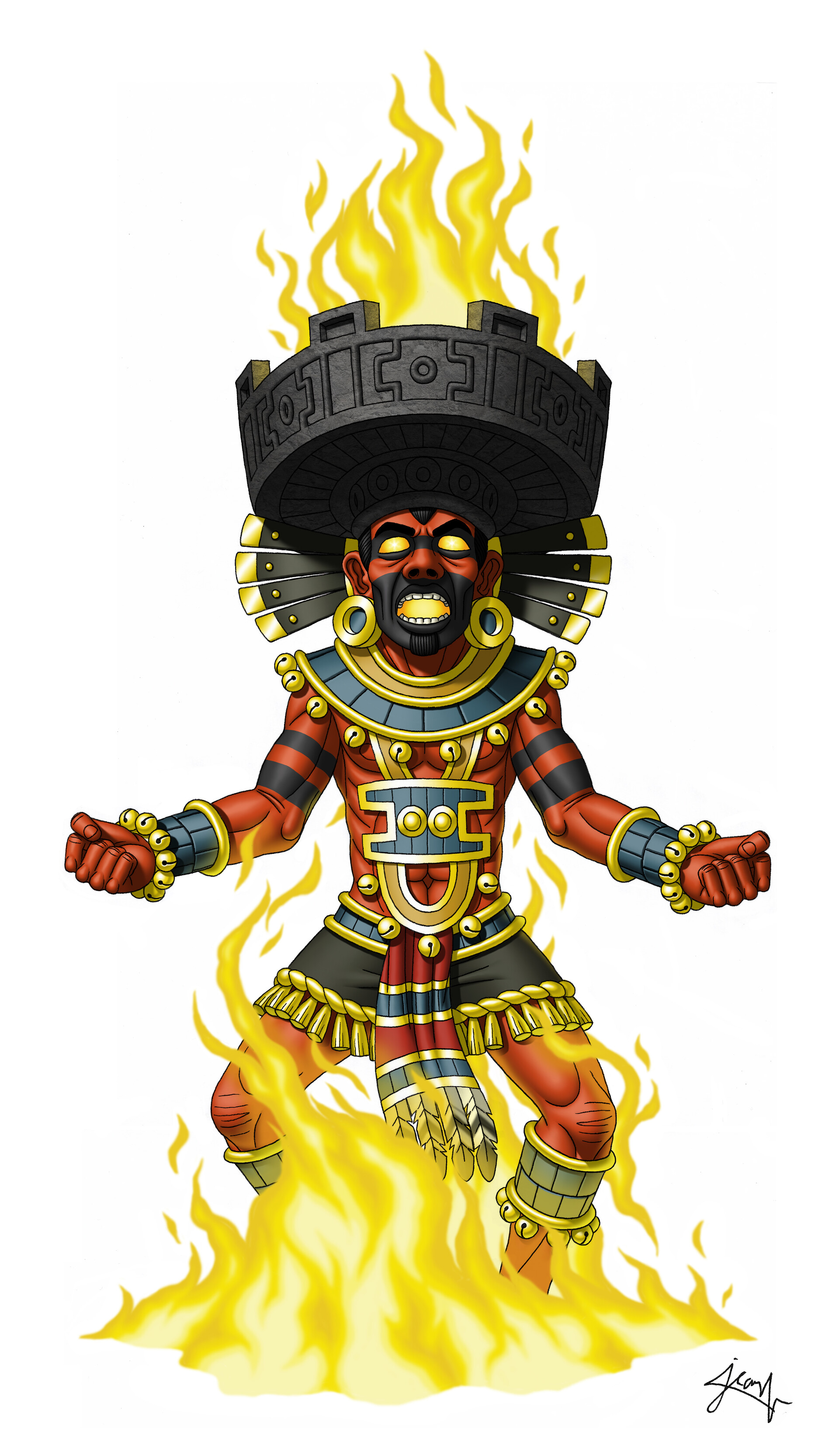
Here’s my take on Xiuhtecuhtli (pronounced “shee-oo-teck-oo-tlee”), one of the most important gods of the Aztec pantheon, associated with fire, time, volcanoes, and the four cardinal points. His name can mean both "fire lord" and "turquoise lord" (turquoise being seen as a palpable manifestation of fire by the Aztecs), but he may be referred to by other titles, such as Huehueteotl (the "old god"), Cuezaltzin (which simply means "flame"), or even Ixcozauhqui ("yellow faced"). He was also seen as the personification of warmth in cold, light in darkness, food in times of famine, and even life after death.
The origins of Xiuhtecuhtli are, however, not always the same depending on the sources, as are his relationships with the other deities of his pantheon. According to the Florentine Codex, he is only a manifestation of the primordial deity Tonacatecuhtli/Ometecuhtli, who created the Earth, made it fertile and populated it, with the help of his half, Tonacacihuatl/Omecihuatl. But according to other sources, he would indeed be a god in his own right, created by the Four Tezcatlipocas (namely Quetzalcoatl, Huitzilopochtli, Xipe Totec, and...Tezcatlipoca) to control the element of fire, just like his consort Chantico, goddess of the hearth. And according to another contradictory source, Xiuhtecuhtli's companion turns out to be Chalchiuhtlicue, goddess of waters and rivers, while the latter, according to the paradigm developed previously, would have been created at the same time as Tlaloc (god of rain and thunder), to control the element of water, again by the Four Tezcatlipocas, which seems more logical. However, the god of fire only had children with Chantico, four in number, whose names mean "blue fire", "yellow fire", "white fire", and "red fire".
The place where Xiuhtecuhtli would reside is not always the same either. According to the Codex Ríos, he lives in the Eleventh Heaven, the Ilhuícatl-Teotlacuauhco (the “Heaven of the Red Region” through which the heat rays of the sun pass), with his consort Chantico and their four children. But according to the research of archaeologist Eduardo Moctezuma, the “fire lord” would rather live at the center of the Earth, in a turquoise enclosure.
Xiuhtecuhtli was of course entitled to festivities in his honor. Every fifty-two years (a sort of equivalent of the European century among the Mesoamerican peoples), the Aztecs began each new calendar cycle with the Ceremony of the New Fire, which had to be successful at all costs, to stop the tzitzimime (dreadful star deities) from descending to Earth and make a massacre. This ritual, carried out by priests of the god of fire, consisted of the ascent of Mount Huixachtlan - an extinct volcano - at nightfall, the extinction of all the fires in the territory, then the sacrifice of a man to the Mountain top. After which, a large torch was placed on his chest, and once the fire was lit, the heart of the sacrificed person was torn out, then given to the flames.
But other rites were performed for him, almost always involving the immolation of animals, foodstuffs, idols of the god, or even copal (a resin whose name aptly means “incense” in Nahuatl). And every four years, a more solemn festival was held at his temple at Tenochtitlan, attended by the emperor and his court; human sacrifices (slaves and prisoners of war) were immolated there after being dressed in Xiuhtecuhtli’s garments, then the children had their ears ritually pierced, before everything ended with a big banquet.
Each Aztec home and temple had to have a brazier in its center, and the flame of which had to be constantly maintained, in honor of Xiuhtecuhtli. It is also this relationship to the central hearth which would have earned the “lord of fire” to be associated with the four cardinal points. Likewise, it is likely that it was the presence of a massive brazier on the head of the god Huehueteotl that led the editors of the Florentine Codex to identify the “old god” – moreover devoid of any connection to other members of the Aztec pantheon – to Xiuhtecuhtli.
Xiuhtecuhtli's nahual (animal form) is the Xiuhcoatl, in other words the "turquoise snake", or "fire snake", sometimes represented on the back of the divinity, but best known for being one of the attributes of Huitzilopochtli, the blue Tezcatlipoca, god of war and of the sun.