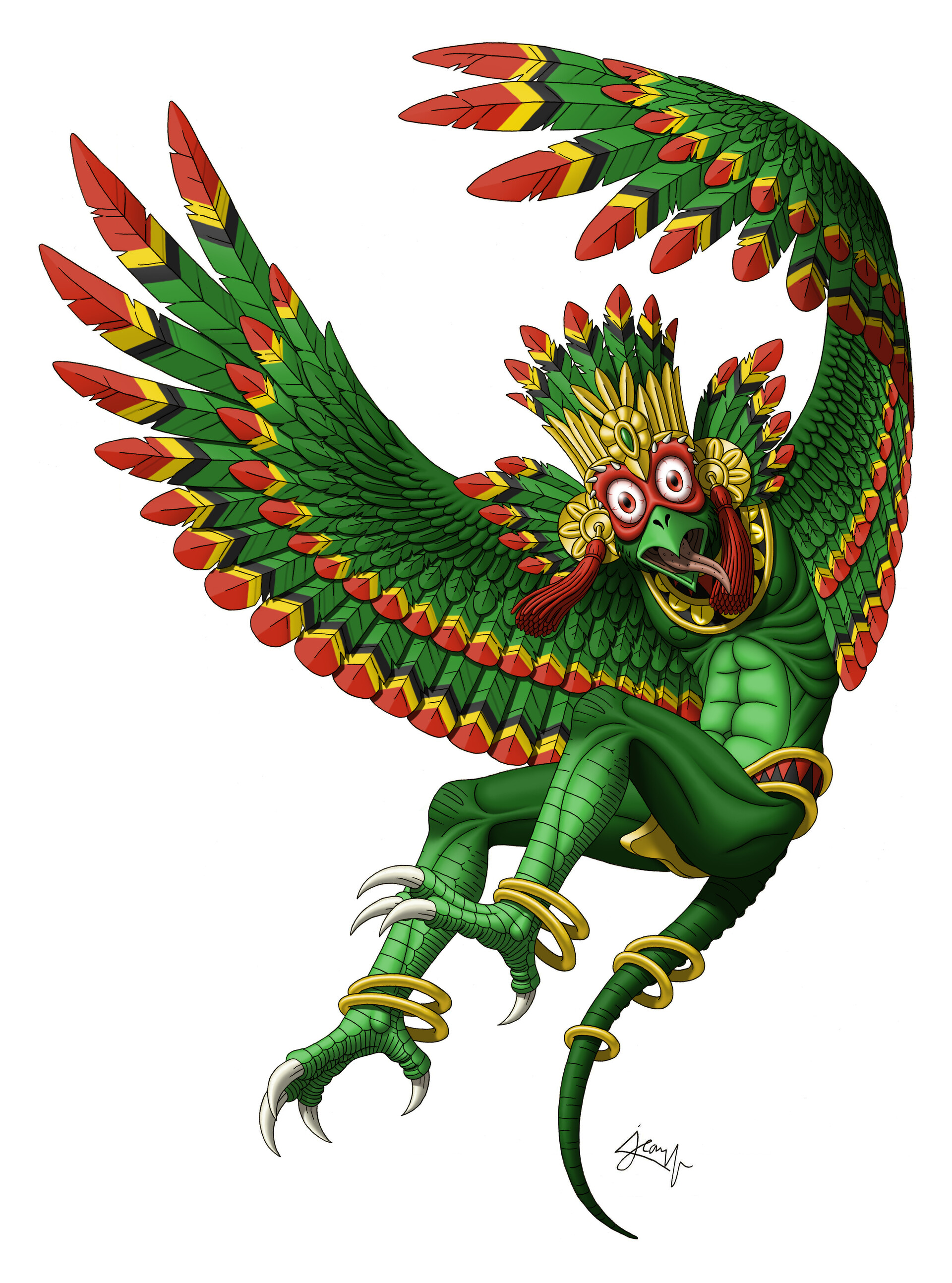
Gurulu
Here’s my take on a Gurulu (or Gurulu Raksha, or the mistranslation Gurr), a category of human flesh-eating bird demon, from the folklore of the Sinhalese, a people representing the majority of the population of Sri Lanka.
Like their compatriots called yaka, the gurulu are massively represented via highly stylized wooden masks, worn by dancers accompanied by drums. But if the dances involving Yaka masks are rituals of exorcism seeking to free the sick from the grip of this type of demon, those performed with Gurulu masks are practiced just for festivals and processions. However, these festivities can also aim to protect from these bird demons, and/or the naga raksha (snake demons), their eternal enemies (who also have their own masks and dances). These two demons are so intimately linked that the vast majority of Gurulu masks feature cobras/najas, sometimes caught in the beak and/or wrapped around.
Moreover, this opposition between the gurulu raksha and the naga raksha leads to a parallel with the one between Garuda, the bird-man serving as a mount for Vishnu, and the nagas, these serpentine creatures living underwater and under the earth, according to Hindu mythology. The transformation of Garuda - a positive figure in Hinduism - into a category of minor demons in Sinhalese folklore takes its meaning in the long and intense competition between the Sinhalese, who are mainly Buddhists, and the Tamil community, who are mainly Hindus. This religious difference dates back to the 3rd century, and the clashes lasted several centuries, with however a Sinhalese preeminence ; but even today, the two ethnic and religious groups tend not to mix.
On the other hand, in the Ramayana (one of the most important Hindu epics, composed between the 3rd century BC and the 3rd century AD), the realm of the rakshasa (the common demons of Hinduism) happens to be the Island of Lanka, mostly perceived as present-day Sri Lanka. The fact that the Hindus of India considered this country as a den of monsters as early as the 3rd century BC. J.-C. betrays once again the long-term conflict between the two religions. The Gurulu isn't the only Sri Lankan monster to be a demonization of a positive Hindu figure, by the way, but we'll get to that in other entries !